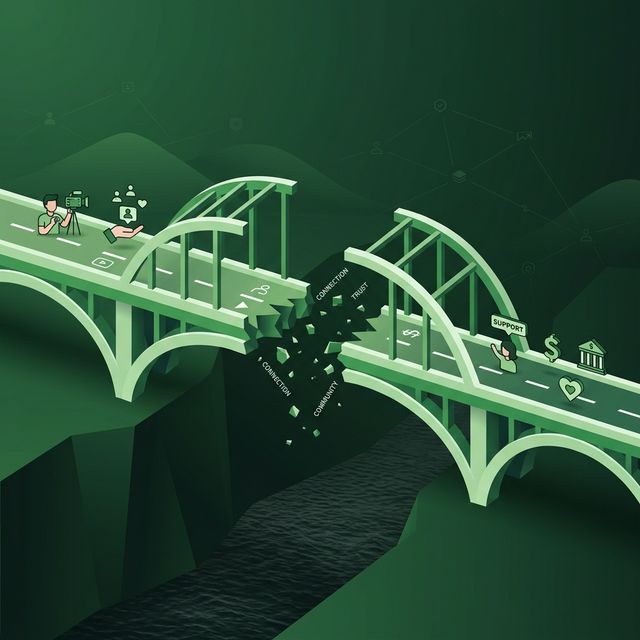
The dream is everywhere. You see it in every scroll of your social media feed. Someone is traveling the world, filming their day, and seemingly making a fortune by "just being themselves." It looks like the ultimate career: total freedom, creative expression, and a direct line to a global audience.
But there is a massive gap between what we see and what is actually happening. For the vast majority of people trying to make it, the creator economy is not a gold mine. It is a grind that rarely pays off. In fact, for 95% of participants, the current system is fundamentally broken. If you feel like you are running on a treadmill that never ends, it is not just you. The math of the internet is currently stacked against the individual.
The Illusion of the Digital Gold Rush
We think the creator economy is a success story because we only see the winners. Algorithms show us the top 1% because their content is the most engaging. This creates a "survivorship bias." We see a few stars making millions and assume the same path is open to everyone else. The numbers tell a different story. In 2025, while the total market for creator marketing reached over $32 billion, the wealth did not spread out. It concentrated. The top performers are doing better than ever, but the "middle class" of creators is effectively disappearing.
To understand why this is happening, we have to look at how the system is built. It isn't just a matter of "working harder." The problems are structural.
Problem 1: The Brutal Concentration of Income
The most glaring of the creator economy problems is how the money is distributed. It is a winner-take-most market. Recent data shows that the top 10% of creators captured a staggering 62% of all payments in 2025. This was up from 53% just two years earlier.
If you look at the very top, the gap is even wider. The top 1% of creators now capture 21% of the total revenue. This leaves everyone else fighting for the remaining scraps.
While the average payment for a campaign might look high on paper, the median creator earnings have actually been falling. In the last few years, median earnings dropped from $3,500 to just $3,000 per year. For half of the people in this space, the "economy" is more of a side hustle that barely covers its own costs.
Problem 2: Building on Rented Land
Even if you manage to grow a following, you don't actually own it. Most creators are entirely dependent on platforms like YouTube, TikTok, or Instagram. These platforms are the gatekeepers of your reach.
This platform dependency is a major risk. Every time a platform changes its algorithm, thousands of creators see their traffic vanish overnight. You might have spent years building a community, but if the "For You" page decides to stop showing your videos, your business effectively dies. Creators are essentially "renting" their audience from the big platforms. The platforms control the distribution, they control the data, and they keep the lion's share of the value created by your work. You are providing the content that keeps users on their app, but they hold all the power.
Problem 3: How Creators Make Money Is Limited
The current models for how creators make money are mostly built for scale. Traditional creator monetization usually falls into three buckets: ad revenue shares, sponsorships, and brand deals. The problem? All three require a massive audience to be viable.
Ad revenue shares are often cents on the dollar unless you are getting millions of views. Brand deals and sponsorships require a professional level of influence and often involve long, unpredictable negotiation cycles. Most brands want to work with the same top-tier names because it is easier for them to manage.
This leaves smaller and mid-sized creators in a trap. They are professional enough to spend 40 or 50 hours a week on content, but not large enough to attract the consistent brand interest needed to pay their bills. It is a cycle of high effort and low, unpredictable reward.
Why the System Isn’t Improving
Many people believe that as the industry matures, it will get better for everyone. Unfortunately, the opposite seems to be true. The barrier to entry is higher than ever.
The internet is now flooded with content. We are in an era of "digital exhaustion." The average person sees thousands of messages a day and has learned to tune them out. To get noticed today, you often need professional editing teams, expensive equipment, and a constant posting schedule.
This "professionalization" of the space has made it harder for the average person to compete. When everyone is using AI to scale their production and teams to manage their growth, the individual creator gets drowned out in the noise. The system isn't breaking by accident; it's reaching a point where only those with existing capital and scale can survive.
A Shift Toward Distribution
The real bottleneck in the internet today isn't a lack of content. It is distribution. Everyone is making things, but very few people have an effective way to get those things in front of the right eyes without paying a platform for the privilege.
A shift is starting to happen. People are beginning to realize that the value isn't just in "creating" the content, but in the trust and attention they hold within their own small communities.
The next phase of the digital economy likely won't be about having the most followers. It will be about the ability to distribute value directly. Instead of competing for a viral moment that might never come, the focus is moving toward how individuals can act as active channels for traffic and engagement.
The Pharoll Model: Distribution Over Audience Size
This is the gap that Pharoll is looking to bridge. Rather than forcing everyone to become a "viral star" just to earn a living, the model focuses on the power of distribution.
Pharoll treats individuals as agents of traffic. You don't need a million followers to be valuable; you just need a relevant network and the ability to share quality content. By moving the focus from "follower count" to "action," it creates a way for anyone to participate in the economy.
It is a protocol that allows people to be rewarded for the truest form of influence: moving a person to take an action. It’s a subtle shift, but it changes the game. It moves us away from being dependent on a platform's algorithm and toward a model where our personal distribution has actual economic value.
The Path Forward
The creator economy as we know it has provided a great service by showing that individuals can build global brands. However, we have to be honest about who it is actually serving.
If we want a digital economy that works for more than just the top 1%, we need to stop obsessing over likes and starts focusing on distribution and trust. The future isn't about more content; it's about better ways to share what matters.
Success in the digital world shouldn't require you to win a literal lottery with an algorithm. It should be based on the real value you provide to the people you reach. Until we change the structure of how we distribute attention, the 95% will continue to struggle. But with new models on the horizon, the balance of power might finally start to shift.